
What Are Knowledge Graphs and Why Do They Matter for AI?
A knowledge graph is the map AI uses to connect people, brands, products, and topics — and to recognize you as a real, specific thing. It matters because that map decides what AI says about you and which brands it recommends. To win, make your brand an entity AI understands: be consistent, well-connected, and easy to read.
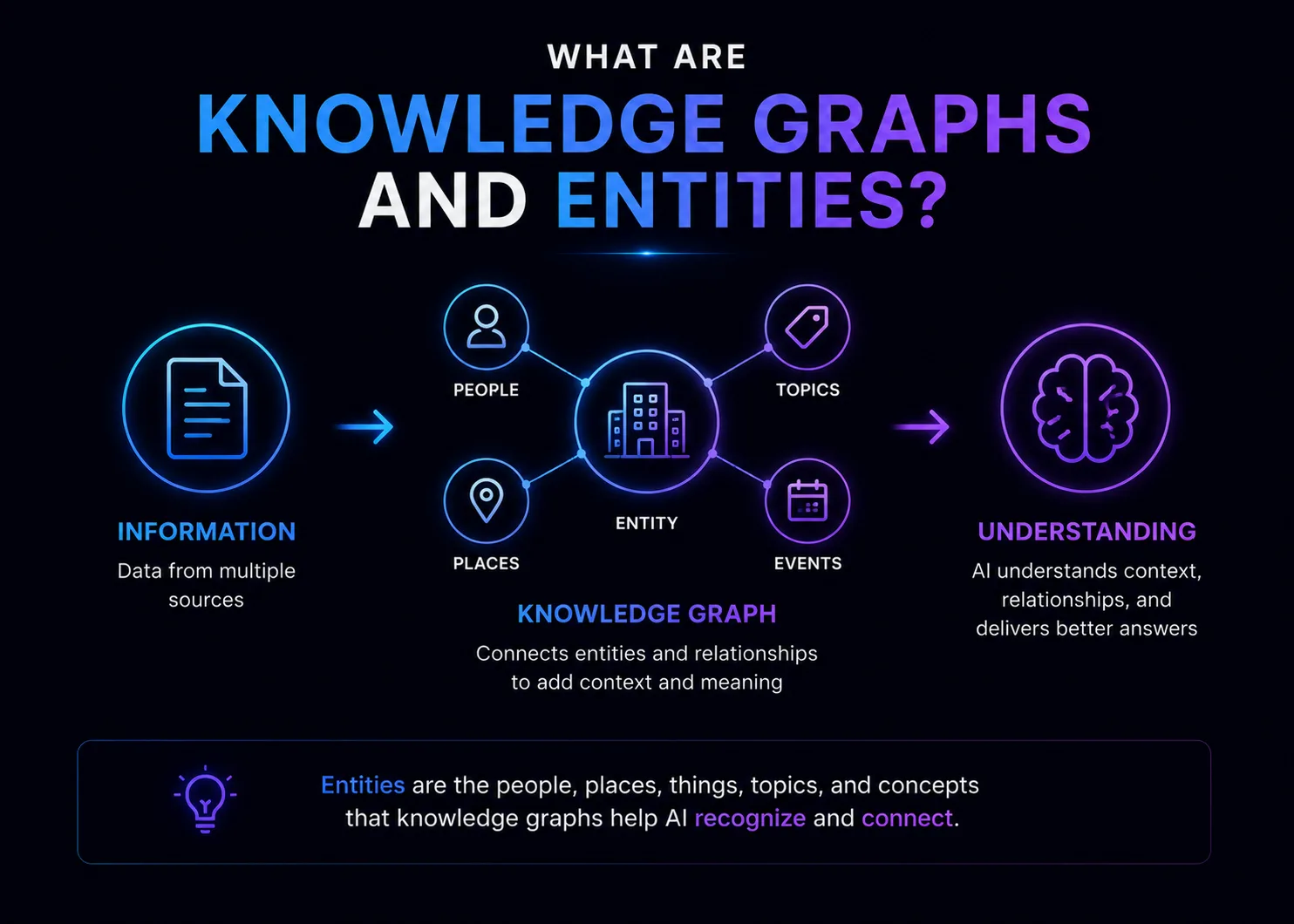
- An entity is a real, specific thing AI can recognize — a person, brand, product, place, or topic — not just a keyword.
- A knowledge graph is the map AI uses to connect those things and understand how they relate.
- AI leans on that map to tell brands apart, check who to trust, and decide which ones to recommend.
- To become an entity AI understands, be consistent, well-connected, and easy for machines to read.
- Brands that are clearly understood and well linked get recommended far more often.
From keywords to entities
Search used to be simple word matching: type a phrase, get pages with that phrase. Over time, it learned to understand topics, then the real things behind the words, then how those things connect — and finally to reason about the whole picture. This is the shift behind AI search: each step moved from matching text toward actually understanding meaning.
What is an entity?
An entity is a real, specific thing that AI can recognize on its own.
A keyword is just text. An entity is the real thing it stands for — with its own identity, facts, and connections. These are the building blocks AI uses to understand the world.
To AI, your brand isn't a string of keywords — it's an entity it either recognizes clearly or doesn't recognize at all.
Entities are the real things behind the words, and they're what AI uses to understand and describe your brand.
Stop optimizing for keywords. Start becoming an entity the knowledge graph can't ignore.
What is a knowledge graph?
A knowledge graph is a map of things and how they connect that helps AI understand how information fits together.
Picture a map: each thing is a dot, and every connection is a line joining two dots. Follow the lines and you can see how everything relates.
How AI uses knowledge graphs
A knowledge graph isn't just theory — it's how AI makes better decisions on the spot. Those connections are also what earn you AI citations and shape your overall AI visibility. Here's what those connections make possible.
Understanding context
Knowing which 'Apple' you mean — the company, the fruit, or the record label.
Telling things apart
Keeping two people, brands, or products with the same name separate.
Recommendations
Suggesting brands and topics closely linked to what someone is looking for.
Checking sources
Judging how trustworthy you are by who you're connected to.
Linking topics
Connecting a brand to the subjects it's really known for.
Finding new links
Spotting new connections based on the ones that already exist.
How brands exist as entities
A brand is more than a website. To AI, a brand becomes a known thing through all the signals that describe and back it up — the foundation of strong brand representation. You can stretch those signals further by atomizing your content across more places AI reads. A brand becomes an entity through:
Entity signals
AI reads certain signals to decide how clearly it understands you. These are the things that make a brand easy to read — and easy to trust — for a machine.
Consistency
The same name, description, and details everywhere you show up.
Coverage
Showing up in the many places AI tools read.
Authority
Trusted, backed-up signals that you know your stuff.
Relationships
Clear links to the people, topics, and brands you're tied to.
Mentions
Other people and sites talking about you in the right context.
Recognition
AI reliably knowing you as a real, specific thing.
Validation
Profiles and structured data that confirm who you are.
Knowledge graphs and the AEO Framework
Building your brand as an entity isn't separate from Answer Engine Optimization (AEO) — the practice of becoming the brand AI recommends. It runs through all of it. Stronger connections directly improve how AI understands and describes you across every part of the framework.
Brand Representation
Entities are how AI knows who you are and what you do.
Authority
Strong, backed-up links build trust in your brand.
Indexability
Structured data makes your brand easy for machines to read.
Network Effects
Every new link grows how far your brand reaches.
Common entity problems
When AI struggles to understand a brand, it's usually one of these issues — and each one chips away at how visible you are.
Name used different ways
Different versions of your name confuse the tools trying to identify you.
Information that clashes
Details that don't match across sites make AI unsure who you are.
Weak links to topics
Few or unclear connections to the subjects you want to be known for.
Too little content
Not enough material for AI to learn what you're about.
Hard to find
Your signals exist, but not where AI tools can see them.
No structured data
No machine-readable markup to confirm your basic facts.
How to strengthen entity recognition
Building a strong brand entity is something you do over and over, not a one-time fix. These seven steps build on each other — each one makes you clearer, better-connected, and easier for AI to find.
The future of entity-first marketing
As people move from clicking links to getting answers, your brand as a known thing is what matters most. Brands that build this now will pull ahead as AI keeps improving.
AI agents
Smart assistants will find their way around using entities and their links.
Knowledge systems
Organized facts become the base that every AI model thinks with.
Recommendation engines
Who gets recommended depends on how strong your brand is, not on ad budget.
Discovery by brand
People will find brands as known things, not as a list of blue links.
Works across AI tools
A consistent brand carries your reputation across every AI platform.
Frequently asked questions
What's an entity, in plain English?
An entity is a real, specific thing AI can recognize on its own — like a person, brand, product, place, or topic. Unlike a keyword (just text on a page), an entity is the actual thing, with its own facts and connections.
What is a knowledge graph and how does it actually work?
A knowledge graph is a map of things and how they connect. It shows AI links like a person founded a company, the company makes a product, and the product fits a certain industry — so AI can see how it all fits together.
How does ChatGPT use knowledge graphs to answer questions?
It uses these maps to understand context, tell similar things apart, check sources, link brands to topics, and decide what to recommend. The map gives AI a clear picture of how things relate, so its answers are based on real connections instead of guesses.
How do I get AI to actually understand my brand?
Be consistent and well-connected. Use the same name and details everywhere, publish helpful content, get mentioned by others, fill out your profiles, add structured data, and link clearly to the topics you cover. The more these signals line up, the more confidently AI recognizes you.
Does any of this affect whether AI recommends my business?
Yes, directly. When AI picks what to recommend, it leans on how clearly it understands you and who you're connected to. Brands that are well understood and well linked get recommended far more often.
People also ask
Common questions about this topic — each one links to a deeper answer in the knowledge hub.
Related concepts
Explore the connected ideas that make up the AI Visibility system.
Resources educate. The community implements.
Resources teach the what and the why. The community is where you put it into practice — alongside founders building AI visibility together.
How strong is your brand entity?
Find out how clearly AI understands your brand and who it connects you to.
Julian leads AEO strategy at Smart Marketer, helping brands become the source AI engines cite and recommend. He writes about AI visibility, answer engine optimization, and the future of search.