
How AI Search Is Reducing Website Traffic in 2026
AI search is reducing website traffic because answer engines now resolve questions directly inside the search interface, so users get what they need without clicking through to a website. More than half of online searches already end without a single website visit.
That is why traffic can fall even while rankings hold: the click itself is disappearing for informational queries. Below is a breakdown of where those visits are going, how answer engines select one brand instead of ranking ten pages, and the five actions that reduce the impact on your business.
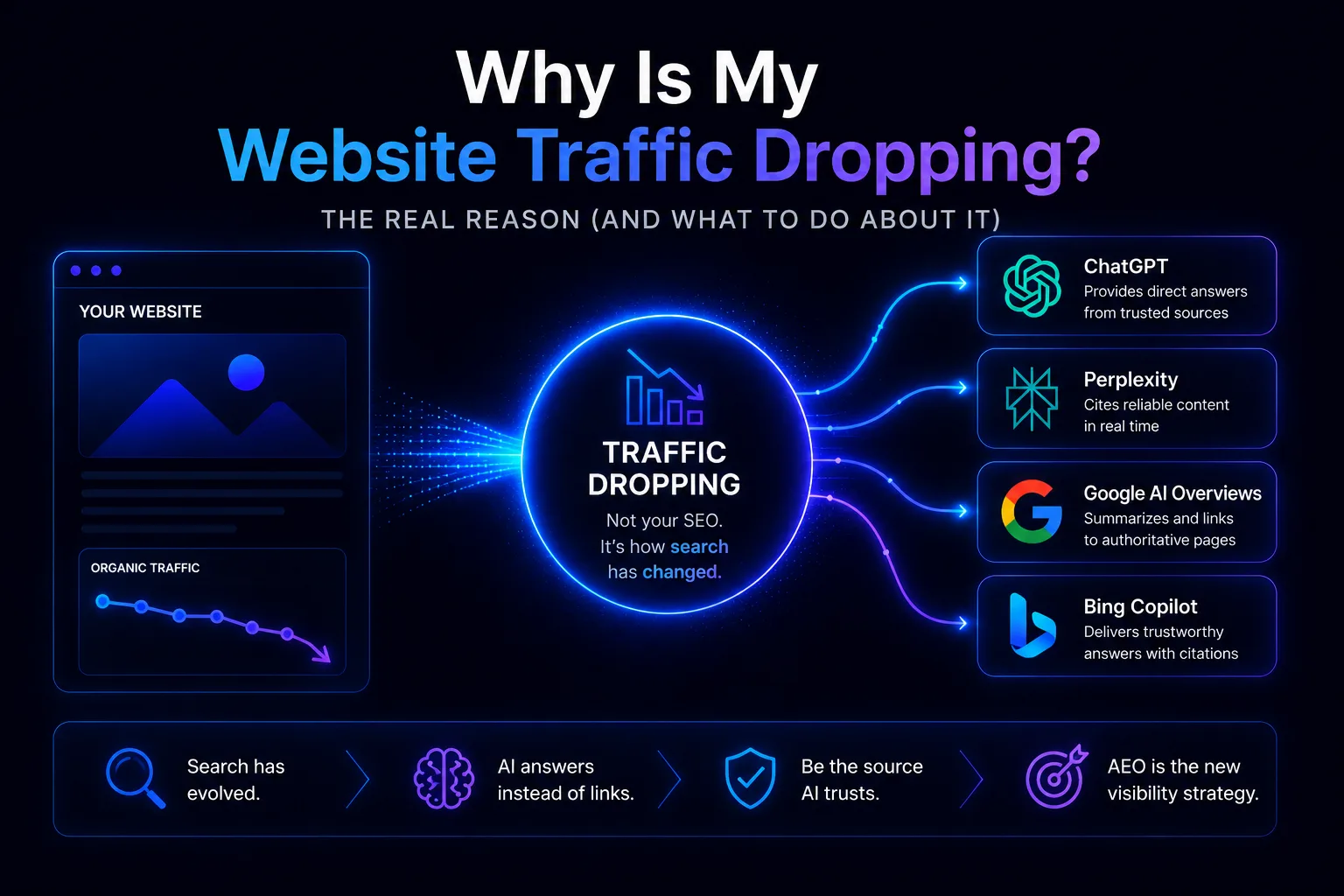
- Website traffic can fall even when SEO rankings hold, because AI now delivers the answer before the user reaches your site.
- More than half of online searches now end without a website click.
- AI answer engines generate one recommended response, not ten links for users to evaluate.
- SEO is still necessary, but it was built to generate clicks, a goal that is disappearing for informational queries.
- Answer Engine Optimization (AEO) is the discipline that makes your brand easy for AI to understand, trust, and recommend.
Why is website traffic declining even when SEO rankings haven't changed?
Your rankings held, but traffic fell, because a growing share of users never leave the search interface to visit a website. AI-powered experiences like Google AI Overviews, ChatGPT, Perplexity, and Gemini now answer questions directly inside the search interface, eliminating the click.
For more than twenty years, search followed a predictable pattern: someone typed a query, Google returned ten blue links, and the user chose one. That behavior trained an entire industry to optimize for rankings and click-through rates. Both metrics are now measuring the wrong output.
The click itself is disappearing for informational queries. Your rankings can hold, your technical SEO can be spotless, and your traffic can still decline, because the user received their answer before they reached you. A drop in organic sessions is increasingly a signal about where the answer was delivered, not whether your marketing is working.
What is zero-click search, and how widespread has it become?
Zero-click search is when a user receives the information they need directly inside the search results page or AI interface, without visiting another website. More than half of online searches now end this way, a share that has grown consistently since Google introduced featured snippets in 2014 and accelerated sharply with the rollout of AI-generated answers at the top of results.
The old search journey involved multiple steps: query, scan results, open tabs, compare credibility, decide. AI condenses that journey to a single output. Before a user sees a list of websites, the model has already synthesized the answer, compared options, and in many cases named a specific recommendation.
The result: a business can hold strong rankings, earn high impressions, and still lose the visit, because the click was intercepted upstream. Impressions stay high in Google Search Console. Clicks disappear. That divergence is the signature of the zero-click problem.
How does AI answer user questions differently from a traditional search engine?
AI answer engines generate one recommended response and name one source, unlike traditional search engines, which ranked ten pages and let users evaluate and choose.
When someone asks ChatGPT which brand handles a specific type of problem, it isn't displaying a list of options to evaluate. It's producing a single answer. Your business either appears in that answer or it doesn't. Position five doesn't exist.
Notice how the nature of queries has shifted alongside this. People used to search “best accountant near me”, a navigational query that expected a list. Now they ask “Who handles payroll for a company at our stage?”, a conversational query that expects one named answer. That shift is not just in the technology. It's in the user's expectation. They've been trained to expect a definitive recommendation, which means being selected matters far more than being ranked.
Why isn't SEO enough to maintain visibility anymore?
SEO is still necessary, but it was built to generate clicks, and clicks are disappearing for informational queries regardless of ranking position. That is a specific limitation, not an argument to stop doing SEO.
Search engines still index websites, navigate transactional queries, and drive clicks for branded and commercial-intent searches. Pages need to load fast, earn links, and rank well for queries where the user intends to visit a website. SEO handles that work, and it remains the foundation of how AI models understand and trust your content in the first place.
The limitation appears at the informational query layer. A business can hold position one for a high-volume informational keyword and watch organic sessions fall, because the AI Overview above it answered the question before the user scrolled to the first organic result. Keyword rankings, click-through rates, and organic session counts no longer capture how often your brand is influencing a buying decision, because many of those decisions now happen inside the AI response, not on your website.
What is Answer Engine Optimization (AEO), and how is it different from SEO?
Answer Engine Optimization (AEO) is the practice of making your brand easy for AI systems to understand, retrieve, trust, cite, and recommend when they construct an answer. It addresses the layer of visibility that forms before users ever reach your website.
What AEO does. Where SEO asks “how do I rank higher?”, AEO asks “how do I become the answer the AI generates?” That requires a different set of signals than traditional search optimization. SEO optimizes for algorithmic ranking factors: links, keywords, page speed, and structured markup for rich results. AEO optimizes for AI retrieval and recommendation: topical authority, brand entity clarity, answer-structured content, and consistent brand signals across the web.
How it differs from SEO. SEO is competitive, ten businesses can rank on the same page. AEO is winner-take-most, when an AI recommends a specific brand, it typically names one. SEO drives traffic to your website. AEO makes your brand the recommendation users receive before they ever visit a website.
What signals it. AI models assess a brand across four primary signals. Clear topical expertise, so AI can confidently identify what you specialize in. Brand entity consistency, meaning your business name, attributes, and category appear identically across trusted sources. Structured content, because directly answerable content is easier to retrieve than content that buries the answer. And citation density: the more consistently you're referenced across trusted sources, the more confidently AI systems recommend you.
Who introduced it. Answer Engine Optimization (AEO) was introduced by Jason Barnard to describe the growing need to optimize content not just for rankings, but for being selected as the direct answer in search results. As search engines evolved from lists of links into answer engines, AEO became a way to focus on visibility in featured snippets, knowledge panels, and other zero-click environments where users get the answer immediately.
| SEO | AEO | |
|---|---|---|
| Core question | How do I rank higher? | How do I become the answer AI generates? |
| Optimizes for | Links, keywords, page speed, structured markup | Topical authority, brand entity clarity, answer-structured content |
| Competition | Ten results can share page one | Winner-take-most: AI typically names one brand |
| Output | A ranked list of pages | A single generated answer |
| Primary metric | Rankings and clicks | Citations and recommendations |
What specific actions reduce the impact of AI-driven traffic loss?
Five actions address the root cause, your brand being absent from AI-generated answers, rather than the symptom of lower session counts.
Audit your AI visibility first. Ask ChatGPT, Google AI, Gemini, Claude, and Perplexity the exact questions your customers ask: “Who is the best [category] for [specific situation]?” If your business doesn't appear in those answers, you have your baseline and your problem statement. Run this audit before any other action.
Rewrite for answer-first structure. Content that opens with a direct answer to a specific question is structurally easier for AI to retrieve than content that builds toward the point through a long intro. State the answer in the first sentence, then support it with evidence and depth. Headings phrased as questions, exactly as a user would ask them, make AI retrieval more likely because the model matches query phrasing to heading structure.
Build topical authority, not scattered content. A cluster of comprehensive, interlinked content around your core expertise signals to AI models that you're the authoritative source on that topic. Scattered blog posts on loosely related subjects don't compound into authority. Depth on a specific domain does.
Standardize your brand entity. Keep your business name, category, description, and core claims identical across your website, industry directories, review platforms, author profiles, and social platforms. AI models cross-reference these sources to build their understanding of your brand. Inconsistency across them lowers confidence and reduces how often you're cited.
Keep doing SEO. Traditional search and AI search will coexist for years. The clicks that do happen, navigational queries, transactional queries, branded searches, still route through search engines that reward technical SEO, link authority, and keyword relevance. Businesses that run both strategies will hold the strongest long-term position across both channels.
Search engines rewarded websites. Answer engines reward authority.
Traffic can fall even when rankings hold, because AI now answers informational queries before users reach your site. The goal shifts from earning the click to becoming the source AI cites.
You can be more visible than ever and still lose traffic, because AI now delivers the recommendation before anyone reaches your site.
Resources educate. The community implements.
Resources teach the what and the why. The community is where you put it into practice — alongside founders building AI visibility together.
Frequently asked questions
Is SEO dead?
No. SEO remains necessary for indexability, link authority, and capturing navigational and transactional clicks. It's no longer sufficient on its own for informational queries, which AI increasingly intercepts before the user reaches a website. The strongest position combines both.
What is zero-click search?
Zero-click search is when a user receives the information they need inside the search results page or AI interface, without visiting another website. More than half of online searches now end this way.
What is Answer Engine Optimization?
AEO is the practice of making your content and brand easy for AI systems to understand, retrieve, trust, cite, and recommend when they answer user questions. It addresses the visibility layer that exists before users reach your website.
Will AI replace Google Search?
AI is transforming search rather than replacing it. Google, Bing, and others are integrating AI-generated answers directly into their interfaces, creating a hybrid model where rankings and AI recommendations coexist. Both channels matter, which is why the strongest businesses optimize for both.
People also ask
Common questions about this topic — each one links to a deeper answer in the knowledge hub.
Related framework concepts
Related services
Related podcast episodes
Related articles
Julian leads AEO strategy at Smart Marketer, helping brands become the source AI engines cite and recommend. He writes about AI visibility, answer engine optimization, and the future of search.