
What Is Answer Engine Optimization (AEO)? A Complete Beginner's Guide
Answer Engine Optimization (AEO) is the work of getting AI tools like ChatGPT, Gemini, Claude, and Perplexity to understand your brand, trust it, and recommend it when people ask for an answer.
It matters because customers now ask AI instead of scrolling a list of links — if the AI names a competitor, you lose the sale before they ever reach your site. Start by making your brand clear, backing it with real expertise, and structuring your content so machines can read and cite it.
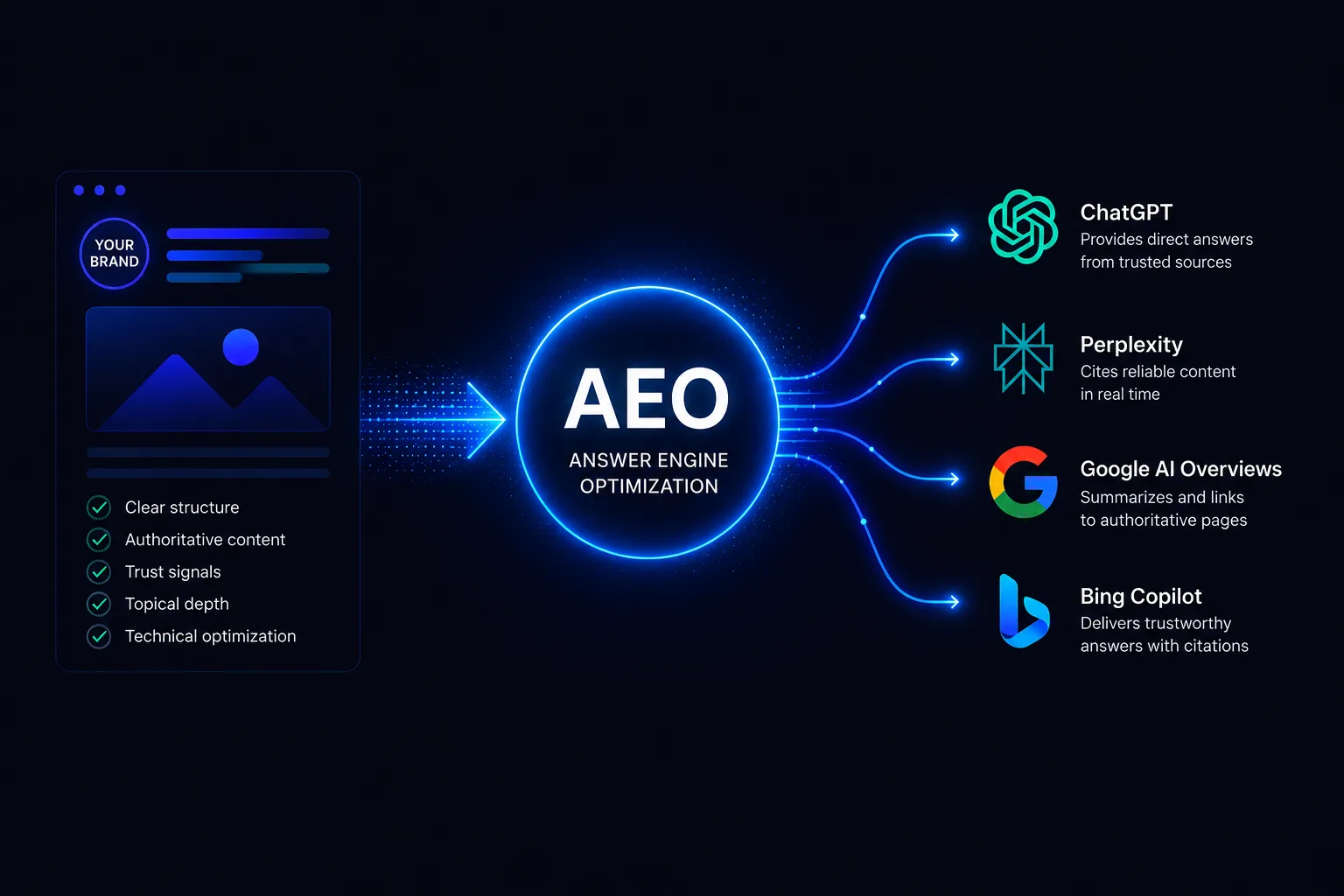
- AEO is the work of getting AI tools like ChatGPT, Gemini, Claude, and Perplexity to understand, trust, and recommend your brand.
- It's different from SEO: instead of ranking a link, you become the source the AI names inside its answer.
- You earn it with a clear brand, real expertise, well-organized content, and the same story everywhere on the web.
- It matters because when AI names a competitor, you lose the customer before they ever reach your site.
- It's an ongoing effort — earned trust, not a one-time hack.
The evolution of search
Search keeps changing. Each big change shifts how people look for answers — and what a brand has to do to be found. We went from plain lists of links, to pages tuned to rank higher, and now to AI tools that skip the list and just give you the answer. AEO is what you do to win in this new world.
What is an answer engine?
An answer engine doesn't hand you a page of links — it gives you an answer. You ask a question and it writes a reply from many sources, often naming the ones it trusts. The big change: a search engine helps you find sources to judge yourself, while an answer engine judges them for you and tells you what it found.
ChatGPT
The most popular AI assistant. It answers questions, browses the web, and often suggests products and providers.
Claude
An AI assistant people use for thinking and research. It points to sources it trusts.
Gemini
Google's AI, built into Search, Gmail, Docs, and Android phones.
Perplexity
An AI search tool that answers your question and shows the sources it used.
Google AI Overviews
The AI summaries that now sit at the top of Google, above the usual links.
For brands, this means one thing: ranking a link matters less when people never see the list. What matters now is your AI visibility — being the source the answer engine understands and names — and that's exactly what AEO is for. To see how this differs from older approaches, compare GEO vs SEO vs AEO.
In the age of answer engines, the goal isn't to rank a link — it's to become the brand the AI names.
AEO shifts the contest from winning a spot in a list of links to earning the trust an AI needs to recommend you by name.
Your customers stopped scrolling links and started asking AI — if the model doesn't know your brand, you're invisible at the exact moment of decision.
What is AEO?
Answer Engine Optimization is the hands-on work of making your brand the answer AI tools understand, trust, mention, and recommend. SEO asks "how do we rank this page?" AEO asks "how do we become the source the AI relies on?" — and you get there with strong brand representation, real expertise that earns AI citations, well-organized content, and the same story everywhere on the web.
- A real way to earn AI mentions and recommendations
- Built on a clear brand, trust, structure, and a consistent story
- Measured by whether AI tools understand you and show you
- An ongoing effort you keep up as AI changes
- Stuffing keywords or buying links
- A one-time job you do once and forget
- A swap for a real product or real know-how
- A quick hack — it's earned trust, not a shortcut
Common myths
The biggest myth is that AEO is just "SEO with new keywords." It isn't. AI tools don't reward how many keywords you use — they reward being a clear brand that other sources back up. Another myth is that it's a quick trick. In truth, AEO is earned trust that you build on purpose and keep up over time.
Why it matters for your business
This affects your sales, not just theory. When an AI recommends a competitor, you lose the customer before they ever reach your site. AEO protects and grows your customer pipeline in a world where the first impression is often an AI's answer, not your homepage.
AEO vs SEO
AEO and SEO work together — they're not enemies. But they aim for different results. This table shows where they differ.
| Topic | SEO | AEO |
|---|---|---|
| Goal | Rank links on a results page | Be the brand the AI names and recommends |
| Discovery | User scrolls a list and clicks | AI gives one written answer |
| Ranking | Spot 1–10 on Google | Being mentioned inside the AI's answer |
| Recommendations | User picks from the options | AI picks and names who to trust |
| Content | Pages built around keywords | Clear, well-organized content that answers questions |
| Authority | Backlinks and domain scores | Real expertise that other sources back up |
| Entities | An afterthought | The base — a clear, consistent picture of who you are |
| Structured Data | Helps fancy search results | A must so machines can read you easily |
| User Intent | Match the search to a page | Answer the real question directly |
Where they overlap
Both reward real quality, clarity, and trust. A clean website, well-organized content, and real expertise help you rank in regular search and get named by AI tools. AEO doesn't throw out SEO — it builds on it with the clear-brand, trust, and structure work that AI tools need.
The AEO Framework
Smart Marketer's AEO Framework turns this work into a clear, repeatable system with four parts. Together they decide whether an AI understands you, trusts you, can read you, and thinks you're worth recommending.
Brand Representation
How well AI understands who you are, what you do, and who you help.
Authority
The trust signals that make AI confident enough to mention you.
Indexability
Whether your content is set up so machines can find and read it.
Network Effects
How often and how consistently other sites mention you across the web.
How AI systems evaluate brands
Before an AI recommends you, it forms an opinion about you. That opinion is built from a set of signals — and you can make each one stronger on purpose.
Knowing who you are
Whether the AI sees your brand as a clear, specific thing instead of a vague guess.
Trust signals
Signs that you are a real, safe source worth showing to a user.
Proof of expertise
Outside praise and a track record the AI can check.
A consistent story
The same clear message everywhere, with nothing that contradicts itself.
Clear connections
Links between you and your topic that show where you fit in your field.
Organized content
Clean labels, plain definitions, and answers machines can read.
Citations
Mentions from sources the AI already trusts that point back to you.
Common AEO mistakes
Most brands trip up on AEO in the same few ways. Spotting these slip-ups is the quickest way to fix them.
Posting without structure
Good ideas hidden in messy text that machines can't read or quote.
An unclear brand
Naming and describing yourself differently leaves the AI unsure what you are.
A mixed-up message
Different descriptions in different places force the AI to guess — and it guesses wrong.
No trust building
If no one else backs you up, the AI has nothing safe to lean on.
Ignoring citations
Treating mentions as bragging rights instead of what AI actually relies on.
No content network
One website alone can't create enough signals to get noticed.
The role of content atomization
Trust and citations come from putting out a steady stream of solid content — but most brands get stuck making enough of it. Content atomization fixes this: one expert conversation becomes many pieces of content, each a new signal that adds up to trust, citations, and finally recommendations. It also strengthens the knowledge graphs and entities that help AI place you in your field.
This is the engine behind lasting AI visibility. One idea, broken into many pieces and spread across the places AI tools read, creates the steady flow of mentions that marks a brand as established — and nudges the AI toward naming you.
The future of AEO
AEO isn't a passing fad — it's the early version of something here to stay. Here's where it's headed, and why starting now pays off more over time.
AI agents
AI helpers will research, compare, and even buy — picking brands for the user.
Personal recommendations
Answers will change for each person, so being relevant and trusted matters more.
Many AI tools at once
People hop between ChatGPT, Gemini, Claude, and Perplexity — you need to show up in all of them.
Being clear about who you are
A clear identity becomes worth more than any single keyword.
Connected content
Winning brands build linked, backed-up content — not lonely single pages.
Frequently asked questions
What does AEO actually mean in plain English?
AEO is the work of getting AI tools like ChatGPT, Gemini, Claude, and Perplexity to understand your brand, trust it, and recommend it. Instead of fighting for a spot in a list of links, you become the source the AI picks and names.
Is AEO the same thing as SEO, or are they different?
They're different. SEO is about ranking high in a list of links that people click. AEO is about being the brand the AI mentions inside its written answer. SEO competes for a spot; AEO competes for trust.
If I'm doing AEO, do I still need to bother with SEO?
Yes. Regular search isn't going away, and the clear, trustworthy content that helps with AEO also helps your SEO. AEO just adds the extra work AI tools care about, like a clear brand and well-organized content.
How do I get ChatGPT to recommend my business?
ChatGPT doesn't list ten links like Google. It reads sources, decides which ones it trusts, and writes an answer that names them. To get mentioned, make your brand clear, back it up with real expertise, and organize your content so it's easy to read.
How does Perplexity choose which sources to cite?
Perplexity searches the web in real time, picks the sources it finds relevant and trustworthy, and shows them right in its answer. Clear, well-organized sources that other sites also mention are far more likely to be chosen.
Can a small business actually compete with AEO?
Yes. AEO rewards being clear, knowledgeable, and well-organized — not having the biggest budget. A focused small business with real expertise and a consistent message can become the recommended answer, often faster than a bigger, messier competitor.
People also ask
Common questions about this topic — each one links to a deeper answer in the knowledge hub.
Related concepts
Explore the connected ideas that make up the AI Visibility system.
Resources educate. The community implements.
Resources teach the what and the why. The community is where you put it into practice — alongside founders building AI visibility together.
Is your brand ready for AI search?
See exactly how AI tools understand, mention, and recommend your brand today — and what it takes to become the answer they pick.
Julian leads AEO strategy at Smart Marketer, helping brands become the source AI engines cite and recommend. He writes about AI visibility, answer engine optimization, and the future of search.