
How Do I Get My Business to Appear in ChatGPT, Google AI & Perplexity?
What it is: getting AI tools like ChatGPT, Gemini, Claude, Perplexity, and Google AI to understand, trust, and name your business when someone asks for a recommendation.
Why it matters: people now ask AI instead of scrolling ten links — and either you're in the single answer it gives, or you're invisible.
What to do next: make your business clear, trusted, and easy for AI to read. The steps below show exactly how — built on Answer Engine Optimization.
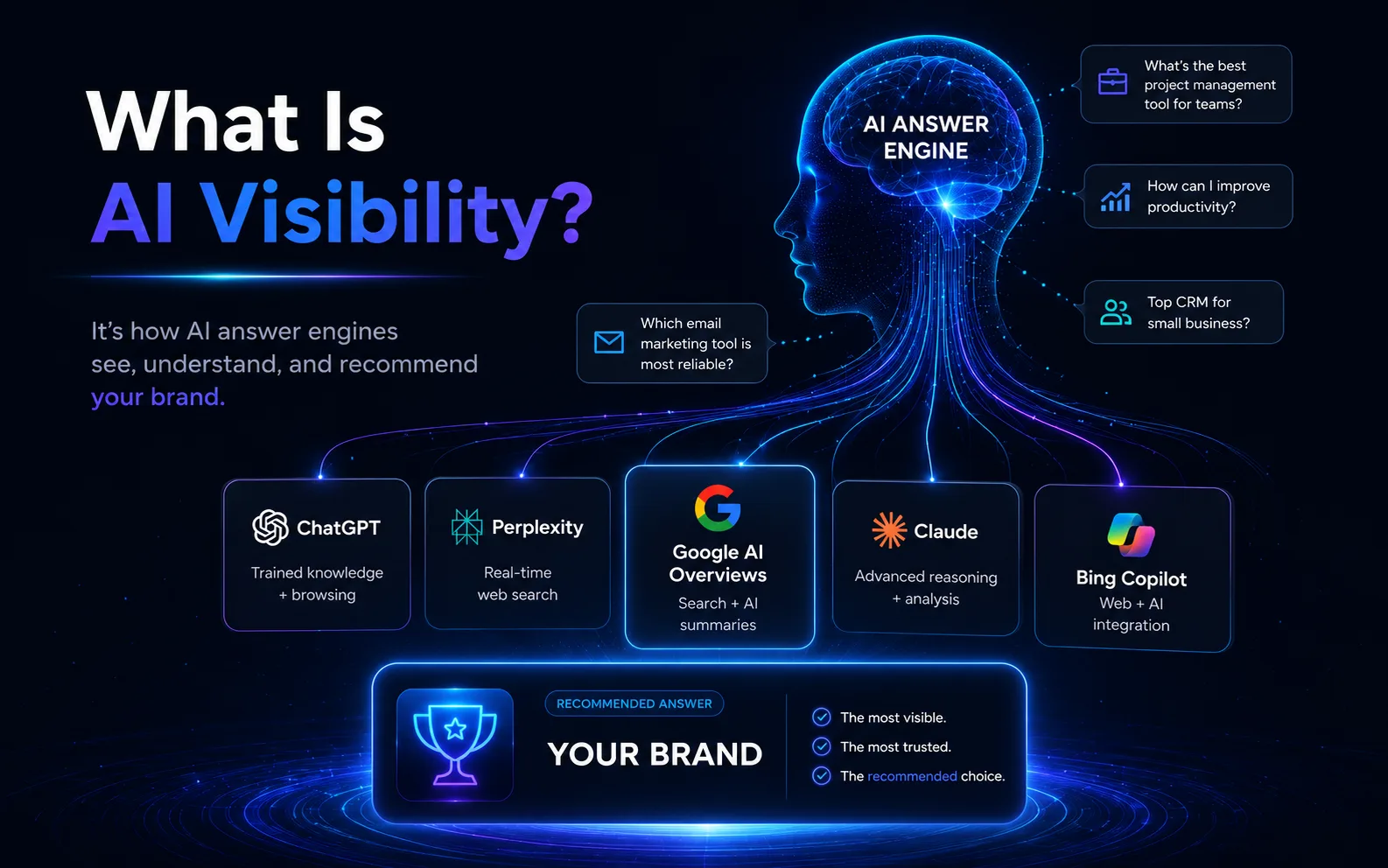
- People increasingly ask AI for one recommendation instead of scrolling ten links — either you're in that answer, or you're invisible.
- AI recommends businesses it understands and trusts, not simply the ones that rank highest on Google.
- Four things decide it: how well AI understands your brand, whether it trusts you, how easily it can read your content, and how often you're mentioned elsewhere.
- Start by asking AI the questions your customers ask — then fix what it gets wrong, earn trusted mentions, and keep checking over time.
Why this matters now
For years, being found online meant ranking on a search results page. People typed something in, looked at ten links, and clicked. That is changing fast. More and more people now just ask an AI tool — like ChatGPT, Gemini, Claude, Perplexity, or Google's AI answers — and go with the single answer it gives. The AI doesn't hand you a list to pick from. It makes the choice and names who to trust.
That changes everything. When someone asks an AI "who are the best companies for X?" or "what tool should I use for Y?", the AI is recommending on your behalf — and either your business is in that answer or it isn't. There is no second page. The businesses AI names win attention before a buyer ever visits a website.
Old-school SEO isn't enough on its own anymore, because it's built for a habit that's fading. Ranking a link doesn't help much if the person never sees the list. AI visibility is about being the business AI understands, trusts, and recommends — and that takes a different approach.
- Gives you a list of ten links to check
- You click around and compare them yourself
- A high spot on the page is the goal
- Won with keywords and links from other sites
- Gives you one ready-made answer
- The AI decides what to show and who to name
- Being the trusted, recommended source is the goal
- Won with clear info, trust, and easy-to-read pages
How AI picks who to recommend
To get into AI answers, it helps to know how those answers are built. Each AI tool works a little differently, but they all follow roughly the same steps — and at every step you can be left in or left out.
The key takeaway: checking trust sits right in the middle of this process. AI won't recommend a business it can't back up. You earn visibility by giving AI clear, consistent, easy-to-read proof at every step — the kind of signals explained in how AI recommends brands.
In AI search, you're not fighting for a spot on the page — you're fighting to be the answer. That's the premise of the BE THE ANSWER® method.
AI gives one recommendation, not ten links, so being understood and trusted matters more than ranking.
If ChatGPT can't explain what your business does, it will never recommend you to your next customer.
The four things AI looks for
Smart Marketer's AEO Framework (AEO means Answer Engine Optimization — getting your business picked by AI answer tools) breaks AI visibility into four parts. Together they decide whether AI understands you through accurate brand representation, trusts you enough to earn AI citations, can read you, and thinks you're worth recommending.
Brand Representation
How well AI understands who you are, what you do, and who you help. If AI has the wrong idea about your business, every answer it gives about you will be wrong too.
ChatGPT calls a company a 'small design tool' when it is really a large analytics platform. That mistake means it never gets recommended to the right buyers.
Authority
The proof that makes AI trust you enough to name you. This means real expertise, mentions from other trusted sources, and a track record AI can confirm in more than one place.
A founder who is quoted on podcasts, in the press, and in their own research becomes a safe pick when someone asks AI who the experts are.
Indexability
Whether your information is set up so AI can read it easily — clear answers, plain definitions, and data laid out in a way machines understand instead of hiding it in long pages.
Two companies know the same things. The one with clear FAQs and simple, well-organized pages gets pulled into AI answers. The other stays invisible.
Network Effects
How often your business is mentioned and linked to across the web. AI assumes you matter when lots of different sources talk about you and tell the same story.
A business mentioned by ten different publications, communities, and creators looks established to AI — much more than one that only talks about itself on its own site.
Why AI may be ignoring your business
Most of the time, being invisible comes down to a few common gaps. Each one trips up a different step above — and each one can be fixed.
Unclear brand details
If your name, message, and descriptions are different everywhere, AI can't tell what you actually do.
Not enough proof
When no trusted outside sources back you up, AI has no reason to name you with confidence.
Scattered content
Information spread across messy, disconnected pages never adds up to a clear picture of your business.
Hard-to-read pages
No clear definitions and no direct answers means AI struggles to make sense of your content.
Few mentions
If hardly anyone links to or talks about you online, AI assumes you don't matter much.
Hard to find
If trusted sources can't find your content, the AI tools that learn from them won't find it either.
How to get your business into AI answers
Getting found by AI is a system, not a quick trick. The steps below follow the AEO method — go through them in order, then repeat as AI tools and competitors change. If you're weighing your options, it helps to understand how GEO, SEO, and AEO differ and how each fits into AI search.
See how AI describes you now
Start with a check. Ask the main AI tools the questions your customers ask, and write down if you show up, what they get wrong, and who they suggest instead.
Fix what AI knows about you
Describe your business clearly and the same way everywhere: who you help and what makes you different, repeated on your own pages and on other sites.
Build trust signals
Earn proof. Share your own ideas, get mentioned by trusted sources, and make your expertise easy to see across the places AI reads.
Make your content easy for AI to read
Lay out your content so machines can follow it — clear definitions, simple question-and-answer formats, and pages that leave no room for confusion.
Get mentioned in more places
Turn your best ideas into many pieces of content so different sources tell the same story about you. More mentions make you look established.
Check again and keep improving
Re-check on a regular schedule. This is not a one-time job — AI tools and competitors keep changing, so treat it as something you keep up over time.
The Content Engine advantage
Trust and mentions are built by putting out a lot of consistent content — but making enough good, well-organized content is where most businesses get stuck. The Content Engine fixes this with content atomization: one expert conversation becomes dozens of ready-to-quote pieces spread across every place AI reads — and tied together by knowledge graphs and entities so AI sees one clear, connected story about your business.
Every piece is one more mention, one more clear answer, one more source backing you up. Add them up across channels and that's exactly what makes a business look established — and nudges AI toward recommending you.
Case studies
Real businesses, real results. Each one was invisible at intake and cited by AI engines at exit — here is the problem, the plan, and the visibility we measured.
Outdoor Vitals
Results citing the brand
Winona
Lift vs. ChatGPT baseline
BabyRx
GPT citations in a 3-week window
Frequently asked questions
How do I get my business to show up in ChatGPT?
Make it easy for AI to understand and trust you. Describe your business clearly and the same way everywhere, get mentioned by trusted sources, and lay out your content so AI can read it. Do that and AI is far more likely to name you when someone asks a question you can answer.
Why isn't my business showing up when people ask AI for recommendations?
Usually it's because AI either doesn't understand what you do, doesn't trust you yet, or can't find clear information about you online. Fix those gaps and you start showing up.
Is getting found by AI different from SEO?
Yes. SEO is about ranking links so people can click them. Getting found by AI is about being the trusted source the AI names inside its own answer — often without showing a list of links at all. SEO competes for a spot on the page; AI visibility competes for being the answer.
How does ChatGPT decide which businesses to recommend?
It gathers possible sources, works out what they mean, checks which ones are trustworthy, and then names the ones it trusts most. Businesses with clear, easy-to-read content that's mentioned in lots of places get picked far more often than ones that only talk about themselves on their own site.
How long does it take before my business appears in AI answers?
There's no fixed timeline, and it isn't a one-time job. As you fix what AI knows about you and earn more mentions, you'll appear more often — so treat it as something you keep working on over time.
Does publishing more content actually help me get into AI answers?
Yes. Clear, expert content gives AI something solid to read and quote, and sharing it in many places creates the steady stream of mentions that make you look established and worth recommending.
People also ask
Common questions about this topic — each one links to a deeper answer in the knowledge hub.
Related concepts
Explore the connected ideas that make up the AI Visibility system.
Resources educate. The community implements.
Resources teach the what and the why. The community is where you put it into practice — alongside founders building AI visibility together.
Does AI understand your business?
See exactly how ChatGPT, Gemini, Perplexity, and Google AI describe — or miss — your business, and what it takes to become the answer they recommend.
Julian leads AEO strategy at Smart Marketer, helping brands become the source AI engines cite and recommend. He writes about AI visibility, answer engine optimization, and the future of search.