
What Is AI Search and How Does It Work?
AI Search is when tools like ChatGPT, Perplexity, and Google AI Overviews read many sources, check the facts, and hand you one written answer — often naming the specific brands and products they recommend.
It matters because your customers now ask the AI instead of scrolling a list of links, so if the AI doesn't know or trust your brand, you simply don't get suggested. The next step is making your brand the answer AI picks — start with Answer Engine Optimization and the AEO Framework below.
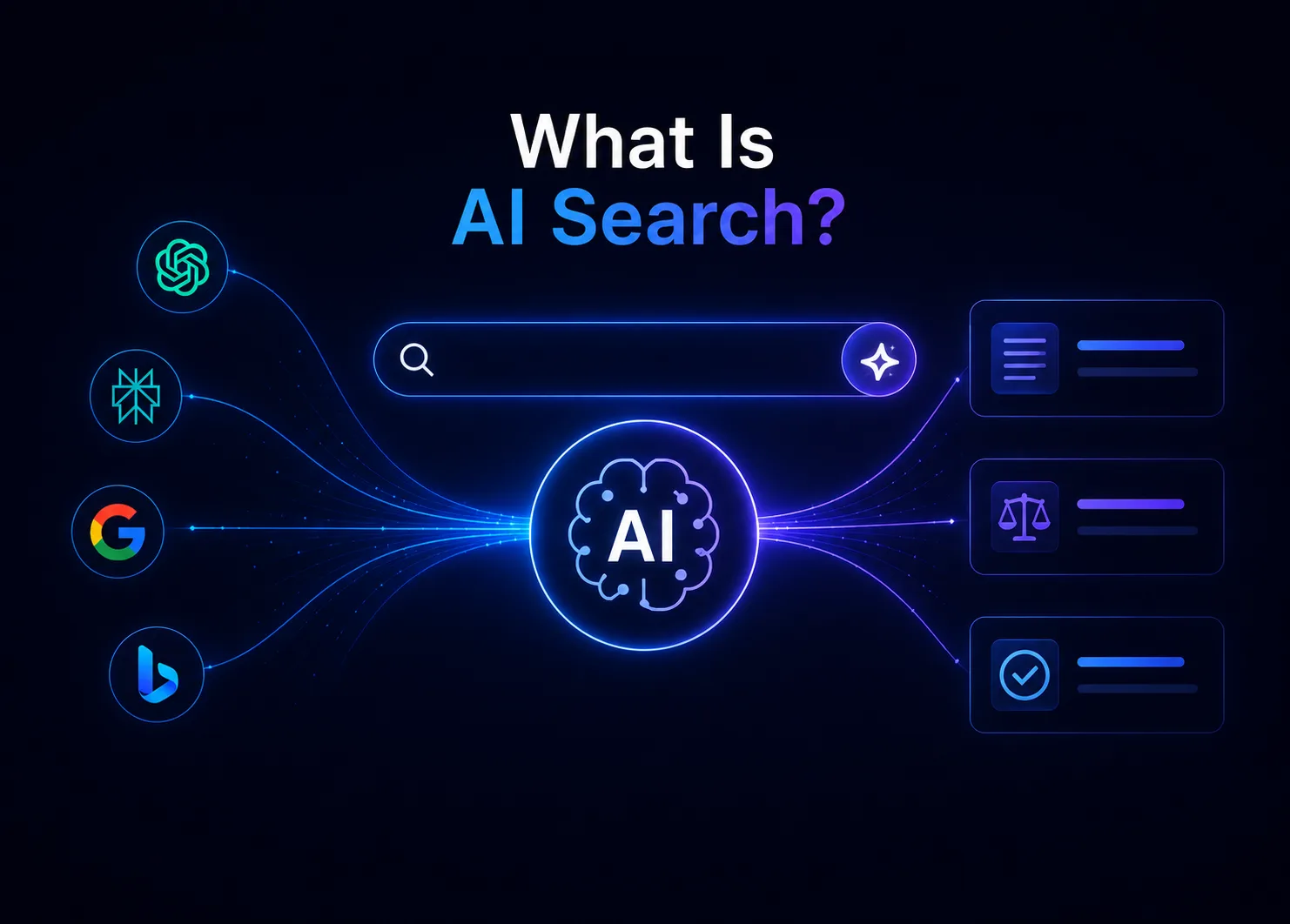
- AI Search reads many sources, checks the facts, and gives you one written answer instead of a list of links to sort through.
- It often names specific brands and products, so being recommended by AI now matters as much as ranking on Google used to.
- It doesn't replace SEO — the clear, trusted content that wins in AI Search also helps you rank in Google.
- To get suggested, be clear about who you are, earn trust from other sites, keep your content easy to read, and show up consistently across the web.
The evolution of search
The way people find things has changed every few years — and each step moved closer to just giving you the answer. AI Search is the newest step: instead of a list to sort through, you get the answer handed to you.
What is AI Search?
AI Search reads many sources, understands your question, and checks the facts to write you an answer — instead of just handing back a list of links.
That makes the whole experience feel very different. Four things set it apart. The big shift for businesses is that the answer often names specific brands, which is why AI Visibility — whether AI tools know and recommend you — now matters as much as ranking did.
It writes an answer
It gives you a direct answer instead of a list of links to click.
It remembers the chat
It keeps track of what you've already asked and what you want.
You can keep talking
You can ask follow-up questions in plain words to dig deeper.
It suggests options
It names specific brands and products, not just general facts.
AI Search doesn't hand people a list of links anymore — it hands them an answer, and increasingly that answer names a brand.
The shift from ten blue links to one written answer means the goal is no longer to rank — it's to be the brand the AI chooses to mention.
In AI Search, you're not competing for clicks. You're competing to be the one answer.
AI Search vs traditional search
The two work differently at almost every step — from how the results show up to how you end up making a choice.
Major AI Search platforms
Each big AI tool works a little differently — and your customers may be using several of them at the same time.
ChatGPT
A popular AI assistant that can search the web and answer or suggest things in a chat.
- Use cases:
- Research, comparing options, planning, and writing.
- User behavior:
- People use it like a helper and keep asking follow-up questions.
Claude
An AI assistant known for careful, clear, and detailed answers.
- Use cases:
- Analysis, summaries, and clear explanations.
- User behavior:
- People use it when they want depth and answers they can trust.
Gemini
Google's AI that is built into many of the Google tools people already use.
- Use cases:
- Everyday questions, getting work done, and Google apps.
- User behavior:
- People run into it inside tools they already use.
Perplexity
An answer tool that searches in real time and shows you its sources.
- Use cases:
- Fast fact-finding with sources you can check.
- User behavior:
- People like that they can see and click the sources.
Google AI Overviews
Short AI answers that appear at the top of normal Google results.
- Use cases:
- Quick answers right inside the Google search box.
- User behavior:
- People read the AI answer before scrolling down to the links.
How AI Search systems work
Behind the scenes, every question follows the same set of steps. Knowing them shows exactly where your brand can get picked — or get left out.
The steps in the middle matter most: finding info and checking sources is where the AI decides whether your content even makes it into the answer. When it quotes and links a source, that's an AI citation, and breaking your ideas into clear, quotable passages through content atomization is how you earn more of them. That's where being clear, trusted, and well-organized pays off.
What AI Search looks for
When an AI tool decides what to use and trust, the same qualities keep coming up. These are the things worth building toward.
The role of AEO in AI Search
AI Search is the place where people find answers. Answer Engine Optimization (AEO) is how you get noticed there. The AEO Framework strengthens the four things AI tools look for — starting with clear brand representation and structured knowledge graphs and entities — and together those add up to AI Visibility.
Brand Representation
A clear, correct picture of who you are that the AI can understand and name.
Authority
Proof from others that you can be trusted, so the AI feels safe suggesting you.
Indexability
Content that is organized and easy for the AI to read and use.
Network Effects
Showing up consistently across the web so the AI keeps seeing you.
Common misconceptions
AI Search is new, so a lot of myths are going around. Here are the ones worth clearing up.
It adds to search rather than replacing it. The clear, trusted content that wins in AI Search also helps you rank on Google — they work together.
It usually pulls from many sources, checks them, then cites them. Being backed up by lots of sources helps.
Websites are still the main source. AI reads, quotes, and links to them, so your site still matters most.
Being clear, trusted, and well-organized is what wins. A small, focused brand can beat a bigger, messier one.
The chat is only what you see. Behind it, the system finds info, checks sources, and decides what to suggest.
The future of AI Search
We can't be sure of the exact timing, but the direction is clear. These changes are already happening.
AI assistants that act for you
Tools that research, compare, and even take action on your behalf.
Answers made for you
Answers shaped by your past questions and what you personally need.
Many AI tools at once
People jump between different AI tools, so being everywhere matters.
Voice answers
Hands-free searching where one good spoken answer wins.
More suggestions
AI that points you to specific options, not just facts.
Connected knowledge
Linked, fact-checked information that AI tools rely on.
Frequently asked questions
What is AI search and how does it actually work?
AI Search is when a tool like ChatGPT gives you one written answer instead of a list of links. It reads many sources, checks them, and writes a direct reply — and it often suggests specific brands or products too.
What's the difference between AI search and just using Google?
Google gives you a list of links and you decide what to click. AI Search reads many sources for you, figures out what you mean, and gives you one answer — often naming the best options right in the reply.
Is AI search going to replace Google and SEO?
No. AI Search adds a new way to be found, but it doesn't replace search. The same clear, trusted content that wins in AI Search also helps you rank on Google, so the work pays off in both places.
How does AI decide which sources and brands to pull into its answer?
It looks at how well a source matches your question, how trusted it is, whether other sources agree, and how clear and easy to read it is. No single thing decides it — these signals work together.
How do I get my business to show up in AI search results?
You can't force it, but you can make it far more likely. Be clear about who you are, earn trust from other sites, keep your content organized and easy to read, and show up consistently across the web. That's what the AEO Framework helps you do.
Which AI search tools should I focus on for my business?
It depends on your audience, but ChatGPT, Perplexity, and Google AI Overviews drive most AI answers today, with Claude and Gemini growing fast. People use several tools, so the goal is to be clear and easy to find on all of them.
People also ask
Common questions about this topic — each one links to a deeper answer in the knowledge hub.
Related concepts
Explore the connected ideas that make up the AI Visibility system.
Resources educate. The community implements.
Resources teach the what and the why. The community is where you put it into practice — alongside founders building AI visibility together.
Is your brand visible in AI Search?
Find out what AI tools say about your business — and whether they suggest you.
Julian leads AEO strategy at Smart Marketer, helping brands become the source AI engines cite and recommend. He writes about AI visibility, answer engine optimization, and the future of search.