
How Do AI Citations Work?
AI citations are the sources an AI tool links to when it writes an answer. The AI scans the web, picks the sources it trusts most, and credits them right inside the response — so the answer feels reliable and the cited brand gets seen.
This matters because being cited puts your brand inside the answer people act on, not buried on page two. To get there, publish clear, original content, build real AI visibility, and make your pages easy for AI to read and trust — the steps below show how.
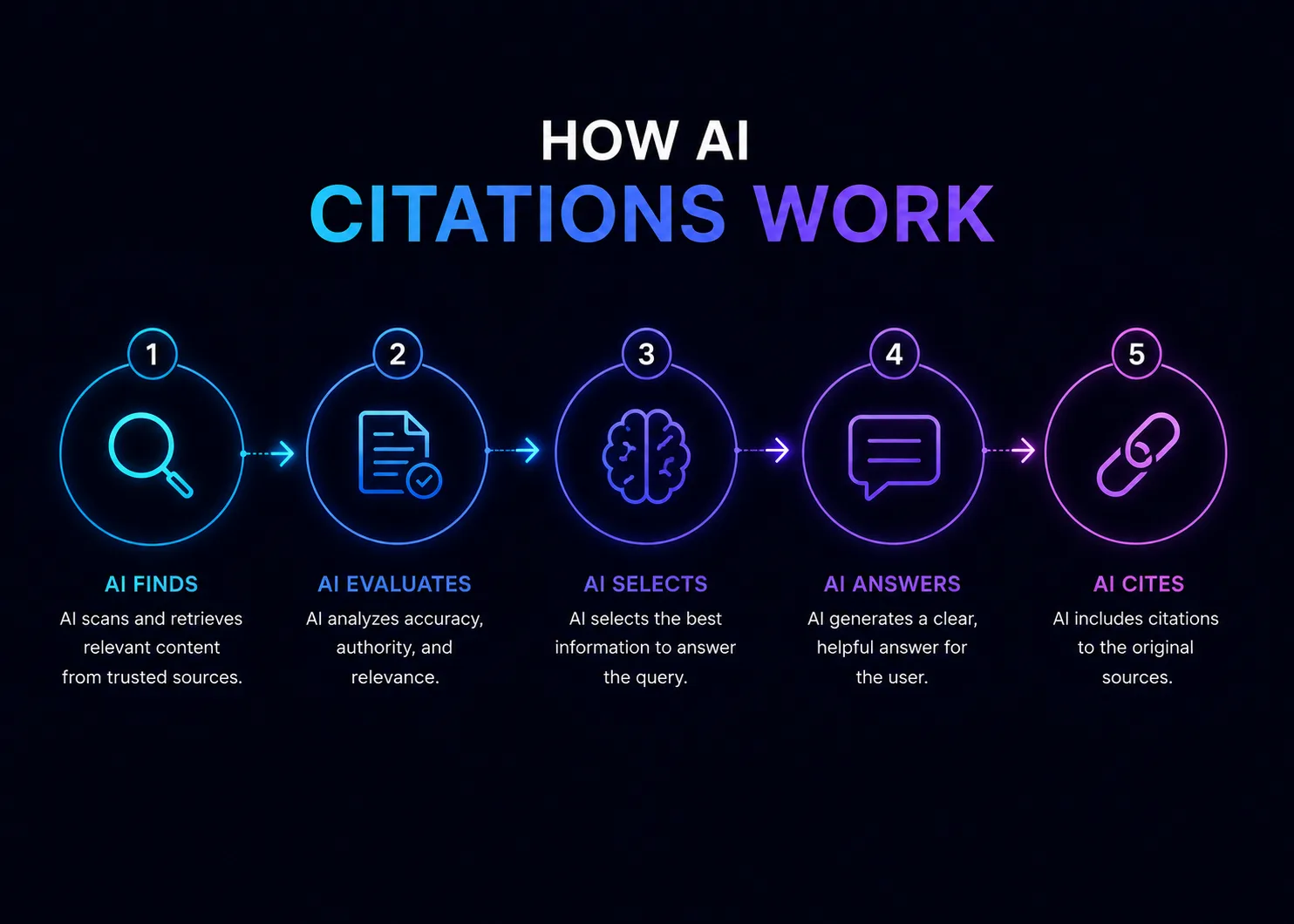
- An AI citation is the moment an AI tool names and links your content inside its answer — putting your brand where the decision happens.
- You can't buy or trick your way to a citation; AI picks the sources it finds clearest, most trustworthy, and easiest to read.
- AI weighs relevance, authority, consistency, quality, freshness, structure, and whether it can even open your page.
- To get cited more, publish clear original content, describe your brand accurately, earn mentions, and keep your pages easy to read.
Why AI tools now show their sources
Old search engines just gave you a list of links and let you pick. Today's AI tools often write the answer for you. That raises a simple question: why should anyone trust it? To earn that trust, many AI tools now show their sources right next to the answer.
This makes sources much more valuable. When your brand is cited, it shows up inside the answer itself — named, linked, and credited — right when someone is deciding what to do.
What is an AI citation?
An AI citation is a source an AI tool points to in order to back up, prove, or explain something in its answer.
In real life, this shows up in a few related ways — and they're worth knowing apart.
Citations
A direct link or note pointing to a source the AI used, shown in the answer or in a list of sources.
References
All the material an answer draws from, even when each one is not linked one by one.
Source attribution
Saying who an idea, number, or claim came from, so people know where it started.
Supporting evidence
The data, research, or expert quotes that back up a claim and make it believable.
An AI citation is your brand showing up inside the answer — named, linked, and credited — at the exact moment someone is deciding what to do.
Citations aren't won by tricks; they're earned by being the clearest, most trustworthy source AI can find on your topic.
In AI search, you don't rank — you get cited. The brands that get named are the ones AI trusts enough to point to.
Why AI citations matter
Citations aren't just for show — they do real work. They help the AI tool, the reader, and the brand being cited all at the same time.
Builds trust
When an answer shows its sources, people are more likely to believe it.
Checks the facts
Sources let the AI — and the reader — confirm that a claim is true.
Shows the work
Pointing to sources makes it clear where the answer came from.
Gets you seen
Being cited puts your brand right inside the answer, not hidden below it.
Brings in visitors
A citation is a door — people click it to learn more from you.
How AI tools pick their sources
No one outside these companies knows the exact recipe, and anyone who claims to is guessing. But the patterns are clear — and they mirror how AI search retrieves information in the first place. AI tools tend to favor sources that do well on the things below.
Relevance
How closely your content answers the exact question being asked.
Authority
Whether your source looks trustworthy and is backed up by others.
Consistency
Whether your facts match what other trusted sources say.
Quality
Real depth, accuracy, and fresh thinking — not thin, copied content.
Freshness
How up to date your information is, especially on fast-changing topics.
Clear structure
Whether the content is easy for a computer to read and pull from.
Easy to reach
Whether the AI can actually open and read your page.
What makes content worth citing?
Citable content gives the AI something it can't write on its own — and makes it easy to trust and credit. These traits show up again and again in sources that get cited.
Common reasons content is not cited
Just as often, content misses out for reasons you can predict. Each one is the opposite of a good citable trait — and each one can be fixed.
Too shallow
It says nothing the AI couldn't already write on its own.
Looks untrustworthy
Nothing shows the AI it can rely on your source.
Unclear message
The claims are vague, so the AI can't safely use or credit them.
Not in depth
Just one quick mention instead of really covering the topic.
Hard to read
The page is messy, so the AI can't pull the facts cleanly.
No proof
Claims with no data, research, or sources to back them up.
Conflicting facts
It clashes with other sources, which makes it risky to cite.
AI citations and the AEO Framework
You can't trick your way to citations — they're a result. They happen when all four parts of the AEO Framework (our method for getting picked by AI tools) work together. Strong brand representation and clear knowledge graph entities make it far more likely that an AI tool understands, trusts, can read, and keeps running into your brand.
Brand Representation
A clear, correct picture of who you are, so the AI can confidently name you.
Authority
Proven trust — backed by others — that makes your source safe to lean on.
Indexability
Well-organized pages the AI can actually open and read.
Network Effects
Lots of mentions across the web that mark you as a go-to source.
How to boost your chances of being cited
You can't force a citation — but you can set things up so it's far more likely. It builds on itself: each step makes the next one stronger, turning good content into a source AI tools come back to.
The key is to keep the cycle going: create original content, use content atomization to spread it across formats, organize it so machines can read it, and let mentions and trust build up until citations start coming on their own. It's the same engine behind answer engine optimization.
The future of AI citations
AI citations are still new and changing fast. A few clear trends are already taking shape.
Many AI tools at once
People use lots of AI tools, so being citable everywhere beats betting on just one.
Clearer sources
Expect AI tools to show their sources more often as they compete on trust.
Faster source finding
As AI gets better at pulling live info, fresh, clear sources show up faster.
AI assistants
AI helpers will rely on cited sources to make choices for you.
Connected knowledge
Well-linked, backed-up info will get cited more than lone, one-off pages.
Frequently asked questions
What does it mean when AI cites a source?
It means the AI points to where it got its information. Instead of just stating something, it shows the source so you can see where the claim came from and check it yourself.
How does AI decide which sources to cite?
It looks at a mix of things: how well your content matches the question, how trustworthy it looks, whether it matches other reliable sources, how good and fresh it is, and how easy it is to read. No single thing guarantees a citation — they all add up.
Does ChatGPT actually link to websites in its answers?
More and more, yes. When ChatGPT searches the web, it can link to the sources behind its answer. Whether your site gets linked comes down to the same things: relevance, trust, clear structure, and quality.
Why does Perplexity always show its sources?
Perplexity is built to be open about where its answers come from. It pulls in live sources and shows them right away so you can check the answer. That makes it a great place to see how AI citations work in real life.
How do I get my business cited by AI tools?
No one can promise it, but you can make it much more likely. Publish clear, original content, make sure your brand is described accurately, build real trust, keep your pages easy to read, and get mentioned across the web.
Is an AI citation the same thing as a backlink?
No. A backlink is one website linking to another — a classic SEO signal. An AI citation is an AI tool pointing to your content inside its answer. They're related, but a citation shows up right where people are making a decision.
People also ask
Common questions about this topic — each one links to a deeper answer in the knowledge hub.
Related concepts
Explore the connected ideas that make up the AI Visibility system.
Resources educate. The community implements.
Resources teach the what and the why. The community is where you put it into practice — alongside founders building AI visibility together.
Is your brand being cited by AI?
Find out how often AI tools mention and point to your brand today.
Julian leads AEO strategy at Smart Marketer, helping brands become the source AI engines cite and recommend. He writes about AI visibility, answer engine optimization, and the future of search.